Featured

Assignment 9: Five Tips For Effective Hashtags

If you use social media, there is no doubt that you know about #hashtags. Whoa, that was meta. Anyone can use a hashtag, but not anyone should. Here are five rules to follow if you don’t want to look like a clown on social media.

  1. Do not overuse hashtags – I get it. You are excited about your cup of coffee that you spent your weekly paycheck on. You want to get as many likes as possible for that dopamine rush. But, please limit yourself on the hashtags – no more than a few per post. This video from Ydraw suggests using no more than two hashtags per post. Personally, I would do no more than five. Using too many hashtags will make you look inauthentic and attention-hungry.
  2. Keep words together – A common mistake that social media rookies make is spacing words in hashtags. Forget what you know about proper grammar when it comes to hashtags. If the words in your hashtag are not together, they will not work. Using punctuation will have the same unwanted effect.
  3. See what hashtags are trending – To stay relevant with your posts, it is important to see what tags are being used related to your content. On Hashtagify you can search a hashtag, and it will tell you what words are popularly paired with your tag on Twitter. It also shows a popularity statistic for the last eight weeks, which countries are using the tags most, and more. See the screenshot below for an example.
  4. Use specific hashtags – If you want to draw a certain audience to your content, you need to make sure that your hashtags are specific. This sounds simple, but it is effective. If you post content about skateboarding, make your hashtags related to skateboarding by including brands, tricks, etc.
  5. Remember which platform you are using – Although hashtags are written out the same way across platforms, how they are written needs to be considered. On Instagram, most tags relate to the content of the post. On Twitter, hashtags are usually more topical or used to join in with groups.
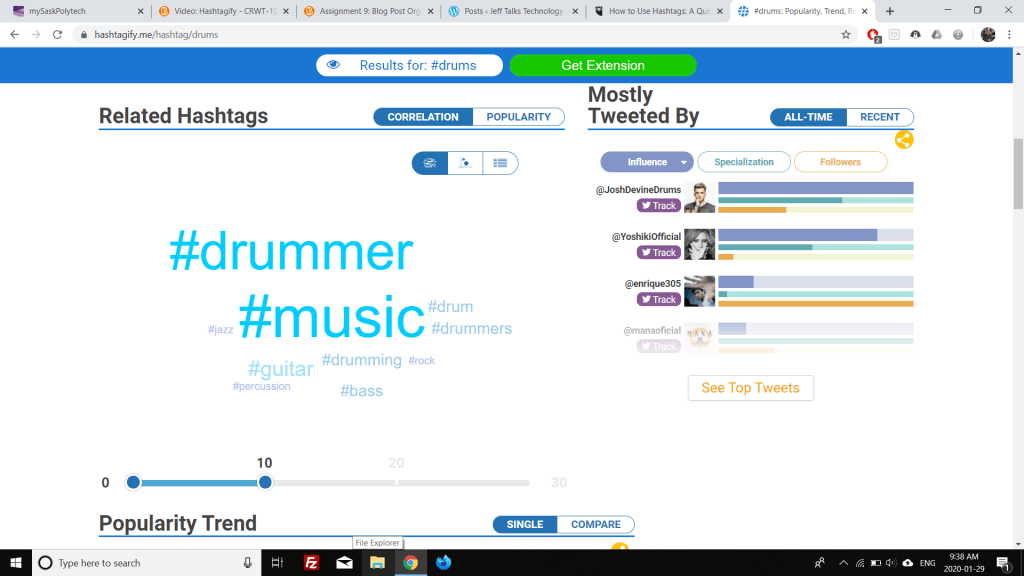
hashtagify.me/hashtag/drums

Let’s recap. If you want to hashtag effectively, you must be aware of how you are writing, what you are writing, and where you are writing. Putting these five steps to practice will improve your content and help attract a greater following.

Sources: Rules 1&2 – Hashtag explainer video – how to use hashtags, by Ydraw. Rules 4 & 5 – How to Use Hashtags: A Quick and Simple Guide for Every Network by Tony Tran

Featured

Clickbait: Will Understanding it Shock You?

A Brief Introduction

My apologies about the title, but I had to draw you in somehow. After conducting some research, I would self-describe clickbait as content that uses strong, inaccurate words in a title to gain views. As you probably know, this is not anything new. Do you remember that nauseous feeling of visiting a new website and receiving pop-up ads that said you won a million dollars? Now this idea has spread to the corners of web on news articles, product pages, and more.

Image by mohamed Hassan from Pixabay

The Facts

In an article from Inc.com, Bill Murphy Jr. summarizes the findings from a study that compared mainstream vs unreliable sources and their use of clickbait. The results found:

  • Mainstream and Unreliable Media both consistently use clickbait
  • 19.46% of headlines were categorized as clickbait in 2014
  • 25.27% of headlines were categorized as clickbait by 2016

Link: These Researchers Studied 1.67 Million Clickbait Headlines. What They Learned Will Completely Shock You https://www.inc.com/bill-murphy-jr/these-researchers-studied-167-million-clickbait-headlines-what-they-found-will-totally-shock-you.html

Perspective

I am not surprised that mainstream and unreliable media both use clickbait, but the results are a bit concerning. Isn’t it the general consensus that people like you and I don’t like content that does not live up to its title? Can companies not be sued for being dishonest toward us, the ones that hand them a paycheck? This is not right.

On the opposite side of the ethics of clickbait, Murphy Jr. notes,

“…there’s nothing sadder for a writer than pouring heart and soul into an online article and finding that nobody reads it”.

These Researchers Studied 1.67 Million Clickbait Headlines. What They Learned Will Completely Shock You – Bill Murphy Jr.

Well, that really puts a damper on things doesn’t it? What are you and I to do about this clickbait problem? I think that if the content is engaging and related to the title, that we should not get too upset over said title. If the content has little to do with the title, it may be time for us to take a stand and blacklist the authors producing online garbage.

Featured

Assignment 6: Memes and Social Media

Oh hey, didn’t see you there! Once again, memes are distracting me from my work. It is nearly impossible to visit a social media platform and not see one. Why have memes become so popular? I believe there are three factors to why memes are so widely used:

  • They are funny and make people laugh
  • They provide fresh and exciting content
  • They are relatable

Memes and Their Importance

I would describe memes as short comics. There is typically a picture and a small joke or reference that accompanies it. Depending on the content, a certain demographic will understand and relate to the meme. When memes first started, there were only a few picture templates to choose from. Now anyone can take a picture of something common, and it can be a meme!

Memes are even used by well-known businesses and brands as a way of advertising. In the article, “How to Use Memes: A Guide for Marketers” by Julia Enthoven, the point is made that memes bring people together.

Memes are funny, and that helps foster community among your followers. They create a sense of belonging because your audience can relate to the situation you refer to and everyone’s in on the same joke.”

How to Use Memes: A Guide for Marketers by Julia Enthoven, https://www.socialmediaexaminer.com/how-to-use-memes-guide-for-marketers/

Water Anyone?

Two summers ago, my family went for a picnic at the University of Alberta Botanic Garden. Like most families, we don’t all have the same taste buds. Some of us like mustard, others think it is a condiment from Satan himself. Some of us like mayonnaise, while others gag just thinking about it. So what did my dad decide to put on them to appease everyone? Neither. They were dry to say the least. The image above was shared with me, and reminded myself and my sister of that memory. Memes are a simple, yet effective way of relating with one another and looking back on the good times in life.

Picture link: https://me.me/i/this-picture-just-got-stuck-to-the-roof-of-my-d7662c7d6abf4dacb2fac6024823cf03

It is moments like these that remind me of the effectiveness of memes. Whether for an individual or a corporation, they help bring people together. So what are you waiting for? Reconnect with the ones around you.

Featured

Three Tips for Effective Blogging as a Millennial (Entertain)

It is 2020 and you know what that means – this is going to be YOUR year as a millennial. This year, your blog is going to stand out to your generation by providing better content and revolutionary ideas. By using these three upcoming tips, the traffic of your blog will skyrocket.

1. Coerce people into spending money. Few people are picking up on this secret, but personal change does not come from within. What people want is something that they do not have. As a blogger, it is your responsibility to enlighten others on what they are missing. Is there a new free-to-start app that has no useful content until payment is received? Recommend it! Do you have a Patreon membership? Talk it up and don’t give away any real perks back to your sponsors. Doing things such as this will boost your appeal to other millennials and your cash flow.

2. Overuse buzzwords. Remember, blogs are tailored to reach a specific audience. Make sure that you are aware of the deep and intricate phrases known as “buzzwords”. Buzzwords are popularly used words that are only culturally relevant for a short period of time. For example, influencers are taking the online world by storm. Their effect is not referred to as influence, but “clout”. Attract your audience by becoming “woke” and embrace this higher level of terminology.

3. Don’t be transparent. It has been a trend for millenials to share personal stories of struggle and pain online. I am here to tell you that this is ineffective to you as a blogger. There is too much negativity in the world, and you are only stressing others more by reminding them of their hardships. People want to find happiness quickly and easily. Make your readers feel good, even if you are not actually doing well.

One final extra tip: Please do not follow any of the advice listed above.

(Dis)Connected to the World Around Us

Social media use among young people is at an all time high, with no signs of slowing down. Coincidentally, the topic of mental health is gradually becoming a more widely discussed topic. My question is, how do these two variables work together? In this blog post, I will be taking a look at a few articles regarding mental health and social media, as well as giving my own thoughts on the subject.

What are your Intentions?

If you spend more time on social media, you are more likely to have depression or anxiety right? A study by Sarah Coyne, a professor at Brigham Young University, tells us otherwise. Over an eight-year span, 500 participants aged 13 filled out a yearly questionnaire regarding their time spent on social media. Participants’ use started at between 31-60 minutes per day. By the time the participants were older, use had increased to over 2 hours a day.

The amount of time spent using social media did not predict depression or anxiety. Coyne suggests that rather than monitoring time, users should:

  • “Be an active user instead of a passive user”
  • “Limit social media use at least an hour before falling asleep”
  • “Be intentional”

Source: https://www.technologynetworks.com/neuroscience/news/does-time-spent-on-social-media-affect-mental-health-326267

Is Anyone There?

An article from Business Insider amalgamated findings across various studies on millennials’ mental health. A study by YouGov found that millennials are the loneliest generation to exist. “30% of millennials said they always or often felt lonely, compared with 20% of Generation X and 15% of boomers.” Additionally, millennials were more likely to respond that they “had no acquaintances, friends, close friends, or best friends.”

Source: https://www.businessinsider.com/millennials-mental-health-burnout-lonely-depressed-money-stress#millennials-are-experiencing-a-health-shock-largely-fueled-by-a-decline-in-mental-health-1

The first article concluded that it is not the amount of time spent on social media that predicts poor mental health. Rather, it is how social media is used that can lead to personal problems. The excerpt I pulled from the second article made no mention of social media, but concluded that millennials are the loneliest generation. What does this mean?

First of all, it is common knowledge that younger generations are more likely be active on social media platforms. Being constantly bombarded by pictures and videos of others showing their best moments is a false reality that influences us, whether we realize it or not. Seeing the “more exciting” lives of others can plant seeds of jealousy and the feeling of missing out. Rather than living in our own present realities, social media can cause us to dwell on other’s lives while neglecting our own. This, I believe, is why millennials are the loneliest generation.

Design a site like this with WordPress.com
Get started